

Review is an essential part of every content creation process. Whether documentation is created for customers, regulators, partners, or internal stakeholders, organizations need an efficient way to gather feedback while maintaining control over content quality and governance. For many review scenarios, review comments are exactly what teams need. A reviewer asks a question, flags a concern, or starts a discussion. The author evaluates the feedback and decides how to proceed. But what happens when a reviewer needs to suggest a concrete content change? This is where Suggestion Mode adds significant value.
Different feedback requires different tools
Not all review feedback is the same. Some feedback is conversational:
- “Can you clarify this paragraph?”
- “Is this specification still correct?”
- “Should legal review this section?”
These types of discussions are handled effectively through change proposals and comment-based workflows.
Other feedback is much more specific:
- Replace a figure with a newer version
- Correct values in a table
- Reorder procedural steps
- Update a warning statement
- Revise a caption
- Modify a product specification
In these situations, describing the change in a comment can become inefficient and prone to misunderstandings.
Instead of writing: “Please replace the image above with the version from the June release, update the caption, and move the component description to the second row of the table.” A reviewer can simply make the proposed change directly in Suggestion Mode.
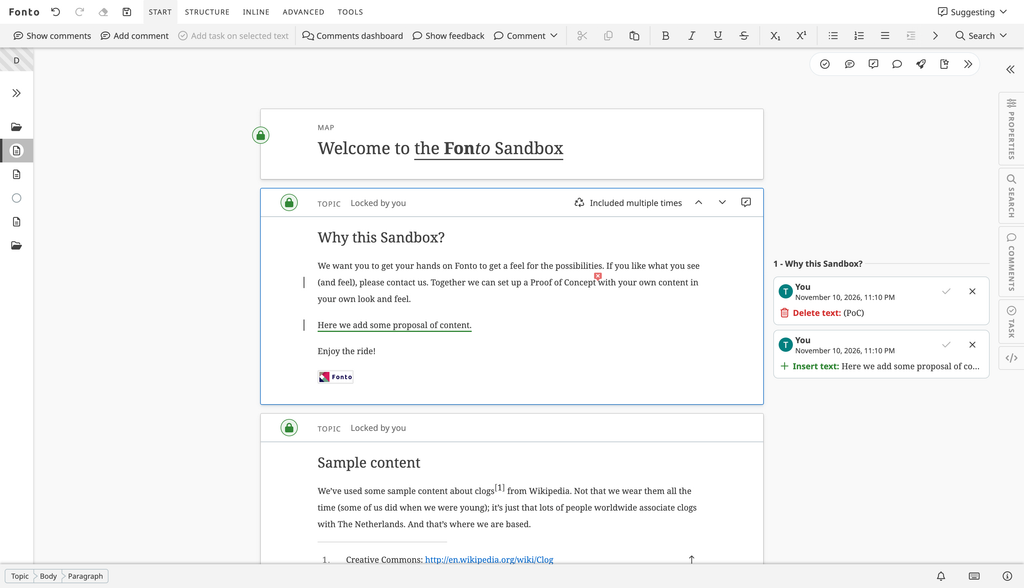
The author can then review, accept, reject, or modify the recommendation as needed.
Reducing ambiguity in the review process
One of the biggest challenges in content review is interpretation. Comments often require authors to translate reviewer feedback into actual content updates. This introduces an additional step where mistakes can occur. Suggestion Mode removes much of this ambiguity. Reviewers can show exactly what they mean by proposing the desired content modification directly within the document structure. Authors no longer need to interpret lengthy comment threads or compare multiple versions of a document to understand the requested change.
The result is:
- Clearer communication
- Fewer review cycles
- Faster resolution of feedback
- Higher confidence in the final content
Especially valuable for complex structured content
The benefits become even more apparent when reviewing structured content. Consider a table containing technical specifications. A reviewer notices three incorrect values. Using comments, they would need to:
- Identify the affected rows.
- Describe each correction.
- Explain the intended replacement values.
- Hope the author applies the changes correctly.
With Suggestion Mode, the reviewer simply edits the relevant cells and submits the proposal. The same principle applies to figures, images, captions, cross-references, and structured content components. Rather than explaining a change, reviewers demonstrate it. For organizations managing highly structured content at scale, this can significantly reduce review effort and increase review quality.
Preserving governance while empowering subject matter experts
Many organizations face a common challenge during review. Subject matter experts possess valuable knowledge, but content owners still need to maintain editorial control. Providing direct editing rights to reviewers may not align with content governance policies. At the same time, limiting reviewers to comments can slow down the process. Suggestion Mode creates a practical middle ground. Reviewers can propose changes without becoming content owners. Authors retain full control over what ultimately becomes part of the published content. This supports stronger governance while encouraging more meaningful contributions from subject matter experts and reviewers.
Accelerating review cycles
Every review cycle introduces cost. Authors spend time interpreting comments, clarifying requirements, implementing changes, and requesting additional review. When reviewers can provide concrete proposals, much of this effort disappears. Organizations can benefit from:
- Faster review completion
- Reduced author workload
- Fewer clarification meetings
- Shorter publication timelines
- Improved collaboration between authors and reviewers
The impact becomes particularly valuable when multiple stakeholders participate in complex review workflows.
Comments and suggestion mode: better together
This is not a choice between the traditional method of reviewing by leaving comments and Suggestion Mode. They address different review needs. Comments remain an excellent solution for discussion-oriented feedback, questions, approvals, and collaborative review conversations. Suggestion Mode complements this capability by enabling reviewers to propose actual content changes when a discussion alone is insufficient. Together, they provide a flexible review experience that supports both communication and content improvement.
Turning feedback into action
Effective review processes are not just about collecting feedback. They are about turning feedback into accurate, high-quality content as efficiently as possible. When reviewers need to suggest adjustments to tables, figures, images, or other structured content components, Suggestion Mode provides a more direct and precise approach than traditional comments alone. By reducing ambiguity, preserving governance, and accelerating review cycles, Suggestion Mode helps organizations move from reviewing content to improving content. And in complex structured content environments, that difference can have a meaningful impact on both content quality and business outcomes.

Customer Success Manager at Fonto – Passionate runner and Dad