

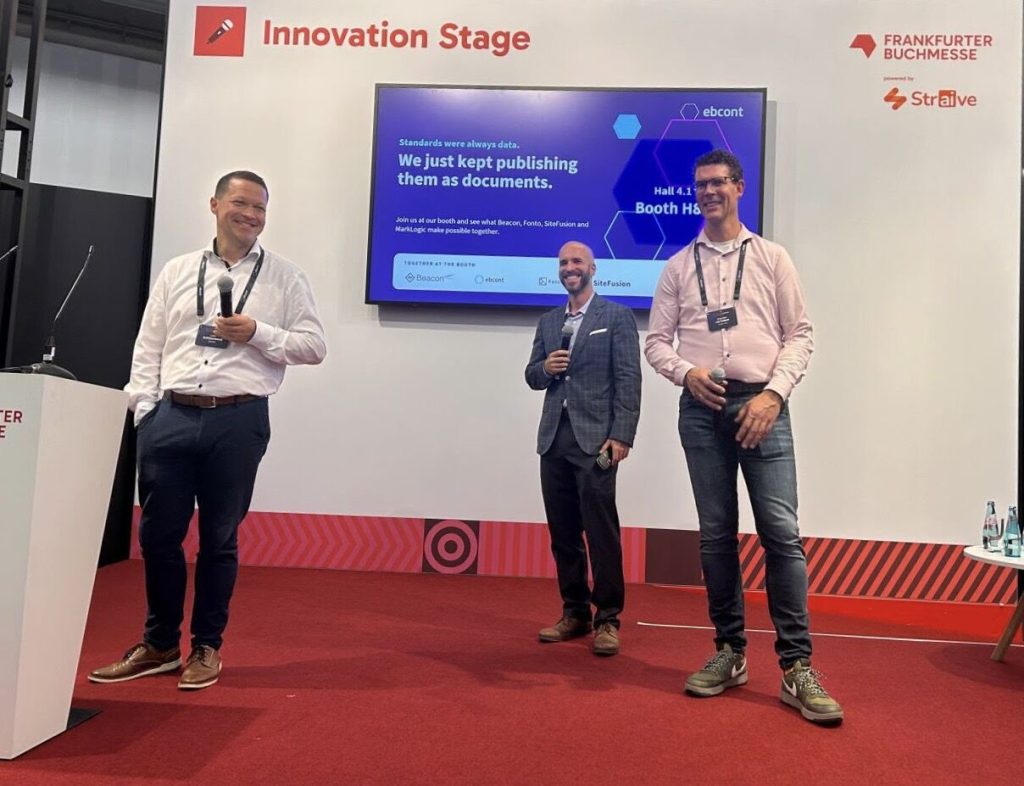
At Frankfurter Buchmesse, the story that resonated most was not about technology. It was about transformation. When Peter Portela, Director of Standards Product Development at the American Welding Society (AWS), took the Innovation Stage alongside Lars Schlatermund from Ebcont and Maarten van Vulpen from Fonto, he described a challenge that many standards organizations, associations, publishers and knowledge-driven enterprises recognize immediately: critical knowledge trapped inside documents.
From documents to data: why standards need a new future
For more than a century, the American Welding Society has developed and maintained standards that guide the welding and joining industry. With hundreds of technical committees and approximately 250 active standards, AWS manages a vast body of highly valuable expert knowledge created through a rigorous consensus process.
Yet despite the importance of that content, the development process looked familiar to many organizations:
- Drafting in Word
- Tables maintained in Excel
- Reviews conducted through email
- Publication workflows dependent on PDF output
- Multiple disconnected systems and tools supporting a single content lifecycle
The result was not a content problem. It was a structure problem. As Peter put it during the presentation, modern organizations cannot solve tomorrow’s challenges by digitizing inefficient processes. The first step is rethinking how content is created and managed in the first place.
Start with the process, not the technology
One of the most valuable lessons from AWS’s journey is that transformation begins long before implementation. Before introducing a new platform, AWS revisited and modernized its underlying standards development process. The organization rewrote its governance rules from the ground up and separated procedural requirements from editorial guidance, creating a more agile foundation for future change.
This reflects a reality we see across many Fonto projects: structured content succeeds when organizations first define how content should work, not just where it should live.
Making structured authoring work for subject matter experts
A key challenge for standards organizations is that their most important contributors are rarely XML experts. At AWS, standards are developed by volunteer subject matter experts. Their expertise lies in welding, engineering and industry practices, not in markup languages or content models. That is precisely where structured authoring must deliver value.
Using Fonto, contributors work in a familiar authoring environment while the platform manages the complexity of structured content behind the scenes. Authors focus on the knowledge they need to capture, while content remains consistently structured and ready for downstream reuse.
The outcome is an important shift: Experts write content. Platforms manage structure.
Why structure matters beyond publishing
Perhaps the most exciting part of AWS’s vision is that the initiative is not primarily about creating better documents. It is about creating better data.
By moving standards into structured NISO-STS XML and enriching content with ontology-based semantics, AWS is preparing its content for entirely new forms of digital consumption and reuse.
The long-term goals include:
- Machine-readable requirements
- Queryable tables and digital assets
- Integration with engineering and requirements management systems
- Enhanced search and discovery
- AI-powered assistance based on trusted content
- Machine-to-machine exchange of standards information
This is where structured content moves from operational efficiency to strategic value.
Standards were always data
One statement from the presentation captured the essence of the journey: “Standards were always data. We just kept publishing them as documents.”
For publishers, standards bodies, associations and enterprises alike, that sentiment extends far beyond standards development.
Most organizations already possess valuable, structured knowledge hidden inside unstructured documents. The opportunity is not simply to publish that content more efficiently. The opportunity is to unlock entirely new digital products, services and experiences.
Ontology-driven content
AWS’s roadmap extends beyond authoring and publishing. Future plans include ontology-driven content models, machine-readable requirements, intelligent assistance and stronger interoperability with other standards organizations and systems.
For Fonto, this project demonstrates a broader industry trend: organizations are increasingly recognizing that content is no longer the final product. Content is the foundation from which many products can be created.
When content is structured, organizations gain the flexibility to publish anywhere, integrate with anything and support entirely new use cases that were not possible when knowledge lived only inside documents. And that is ultimately what this transformation is about: turning expert knowledge into a future-ready digital asset.

Customer Success Manager at Fonto – Passionate runner and Dad